
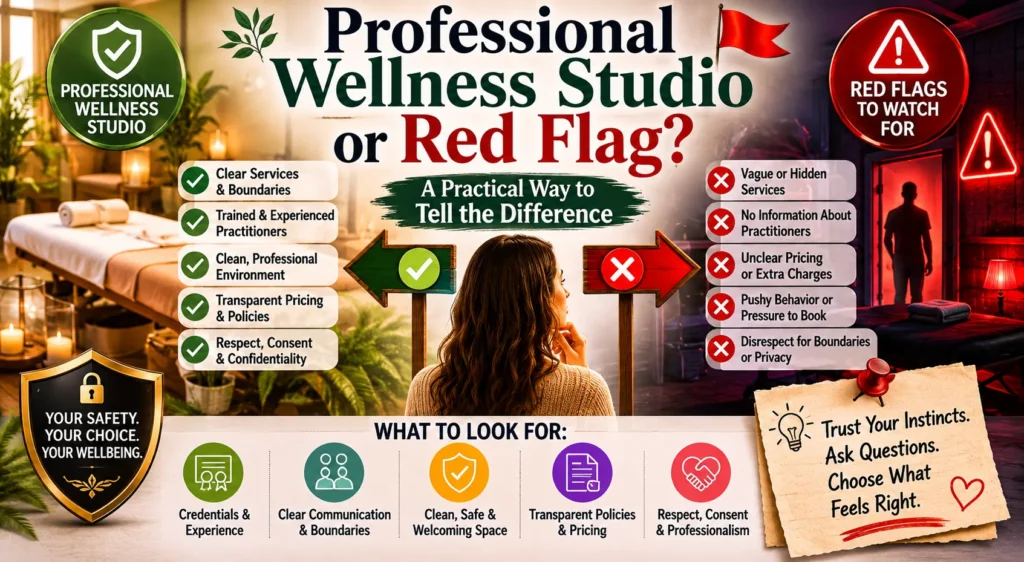
Professional Wellness Studio or Red Flag? A Practical Way to Tell the Difference
Why This Search Feels Confusing in the First Place
Type “tantric massage” into a search engine and you’ll get a strange mix of results. Some look like polished wellness brands — calm photography, mindfulness-focused language, descriptions that sound like a high-end spa. Others feel vague, oddly coded, or strangely evasive about what they actually offer.
For someone genuinely interested in a relaxing, professional experience, this mix can be genuinely confusing. Part of the problem is the word itself: “tantra” gets used so loosely online that it can mean almost anything, from a serious wellness practice rooted in breath and mindfulness to little more than a marketing label with no real substance behind it.
The good news is that the difference between a legitimate studio and a questionable one tends to be fairly visible once you know what to look for — and most of the signals show up before you ever book anything.
Start With How They Describe the Service
The clearest early signal is simply how a studio talks about what it offers.
A professional studio tends to explain, in plain terms, what a session involves, what the setting is like, how bookings work, what’s expected of clients, and how privacy is handled. The tone is usually calm, informative, and grounded — you come away feeling like you understand what you’re walking into.
A studio that feels deliberately vague — relying on innuendo, avoiding direct descriptions, or seeming designed to keep you guessing — is sending a different signal. If you finish reading a service page and still have no real idea what actually happens during a session, that’s worth noticing.
Pay Attention to How They Communicate Before You Book
The conversation before booking often tells you more than the website does.
A professional therapist or studio tends to answer practical questions directly: what the session involves, how long it runs, whether it’s suitable for someone trying it for the first time, and how boundaries are handled. The exchange usually feels patient and unhurried, even if you ask several questions.
By contrast, it’s worth being cautious if a business avoids direct answers, seems focused mainly on getting payment quickly, uses pressure or urgency, or communicates inconsistently from one message to the next. None of these are subtle once you notice them — and they’re rarely present in genuinely professional wellness businesses.
Consent Should Be a Normal Part of the Conversation
Perhaps the single clearest dividing line is how openly a studio discusses consent and boundaries.
In a professional setting, this isn’t an awkward subject — it’s just part of how the service works. You should expect a normal conversation about comfort levels, what you’re open to, what you’re not, and the simple fact that you can pause or stop at any point. This isn’t a special accommodation; it’s baseline practice.
If a studio seems to actively avoid this topic, treats questions about boundaries as strange or unwelcome, or gives the impression that things are simply “decided” once a booking is made, that’s a significant warning sign — not a minor one.
The Atmosphere Should Feel Like Wellness, Not Mystery
When you actually arrive — or even just look at photos and descriptions — a professional environment tends to resemble what you’d expect from any quality wellness space: clean, calm, well-organized, with attention to detail in lighting, music, and presentation. Booking systems are clear. Nothing about the process feels chaotic or improvised.
A questionable environment often feels different in ways that are hard to miss once you’re looking for them: rushed, unclear, inconsistent, or oddly secretive about basic logistics. A genuine wellness experience should make your nervous system settle, not put it on alert — and that should start from the moment you walk in, not just once the session begins.
What Reviews Can (and Can’t) Tell You
Reviews are useful, but it helps to read them with some attention to what they’re actually saying.
Reviews of professional studios tend to mention specific, grounded things: feeling relaxed, the atmosphere being calming, things being clearly explained, feeling respected and comfortable throughout. These are the kinds of details people naturally mention when an experience genuinely felt like wellness.
Reviews that feel repetitive, oddly generic, focused entirely on excitement with no mention of professionalism, or strangely uniform in tone are worth treating with more skepticism. Real wellness experiences tend to generate varied, specific feedback — not a wall of similar-sounding lines.
Privacy Isn’t a Bonus — It’s Baseline
Discretion matters in any wellness context, and tantric massage is no exception. A professional studio handles bookings, communication, and arrival in a way that respects your privacy by default — not as a special request.
You shouldn’t come away feeling exposed, judged, or like your personal information was treated carelessly. In a city where many people value privacy as much as quality, this is one of the more understated signs of a studio that takes its responsibilities seriously.
A Simple Test: Ask Questions
One of the most reliable ways to assess a studio is also one of the simplest — ask questions, and pay attention to how they’re answered.
Reasonable things to ask include what training or experience the therapist has, how a session is structured, what boundaries look like in practice, whether it’s appropriate for someone new to this, and how client comfort is handled throughout.
A professional therapist tends to answer these calmly and directly, often welcoming the questions as a normal part of building trust. An operator running something less legitimate is more likely to become evasive, irritated, or vague — and that reaction is itself useful information.
The Language Itself Is a Clue
Pay attention to the vocabulary a studio uses. Professional, wellness-oriented businesses tend to gravitate toward language about relaxation, mindfulness, body awareness, emotional wellbeing, and calm — because that’s genuinely what they’re offering, and because that’s what most clients are actually looking for: relief from stress, overstimulation, and mental fatigue, not intensity for its own sake.
When the language leans heavily on urgency, implication, or excitement with little mention of professionalism, comfort, or boundaries, it’s often a signal about what the business is actually built around.
Red Flags Worth Taking Seriously
A few patterns are worth treating as genuine warning signs rather than minor quirks: avoiding any discussion of boundaries, applying emotional pressure to book quickly, communicating in a way that feels deliberately unclear, refusing to answer straightforward questions, creating discomfort during the booking process itself, or making promises that sound unrealistic.
None of these need to all be present to matter — even one or two should be enough to make you pause and look elsewhere.
What It Comes Down To
In the end, the distinction is less about any single detail and more about overall intention. A professional studio is built around wellness — and that shows up consistently in how it communicates, how it handles consent, how private it keeps things, and how it treats your questions.
A less legitimate operation tends to feel transactional first, with wellness language layered on top. Most people can sense this difference fairly quickly, even if they can’t immediately articulate why — and it’s usually worth trusting that instinct.
Final Thoughts
Approaching tantric massage like any other premium wellness decision — researching calmly, asking direct questions, and paying attention to how a business communicates — tends to filter out the studios worth avoiding fairly quickly.
A trustworthy provider should leave you feeling informed, respected, and free of pressure before a session even begins. That foundation — built on clear communication, consent, privacy, and professionalism — is ultimately what separates a genuine wellness experience from one that isn’t.
FAQs
What’s the fastest way to tell if a studio is legitimate?
Look at how clearly they describe the service and how they respond to direct questions — clarity and openness are strong positive signals.
Should consent and boundaries come up before booking?
Yes. A professional studio treats this as completely normal, not as an awkward or special topic.
Do reviews actually help? They can — specific, grounded reviews mentioning professionalism and comfort are a good sign, while generic or repetitive reviews are less reliable.
What questions are reasonable to ask before booking?
Therapist experience, how the session is structured, how boundaries are handled, and whether it’s suitable for first-time clients are all fair, normal questions.
What’s the single biggest red flag?
Avoidance — of clear descriptions, of direct answers, or of any discussion about boundaries and consent.