
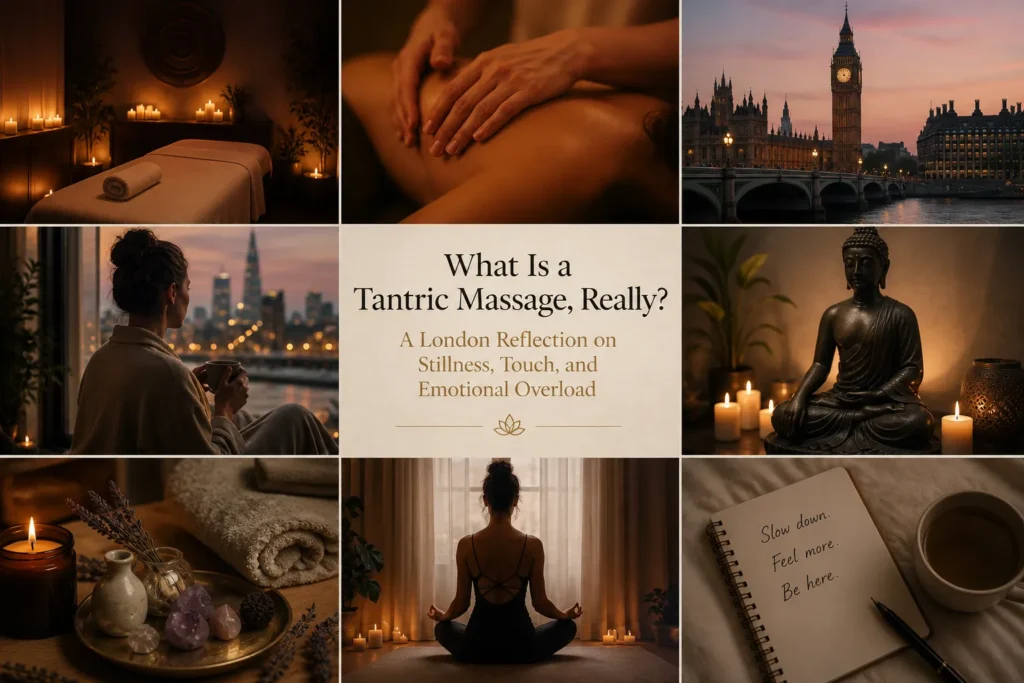
What Is a Tantric Massage, Really? A London Reflection on Stillness, Touch, and Emotional Overload
There is a kind of tiredness London teaches people to hide well.
It does not always look like exhaustion. Sometimes it looks like a well-cut coat, a flat white carried between meetings, a polite smile in a lift, a calendar filled so tightly there is no room to feel anything properly. The city rewards movement. It admires composure. It rarely asks whether the person moving so efficiently through the day is still able to feel at home inside their own body.
That is often where the question begins.
Not loudly. Not dramatically.
Someone hears the phrase tantric massage and becomes curious, but beneath that curiosity is usually something more private. A wish to slow down. A sense of being too mentally crowded. A feeling that ordinary rest is no longer reaching the places where tension actually lives.
So, what is a tantric massage?
At its most thoughtful, it is not simply a massage technique. It is a slower, more conscious form of body-based relaxation that invites the person receiving it to become aware of breath, sensation, tension, emotional guarding, and physical presence. In a city like London, where many people live from the neck upward, that can feel unexpectedly confronting.
Stillness is not always easy for people who have spent years being efficient.
The Body London Forgets
London has a strange way of separating people from themselves.
A person can move from Shoreditch to Mayfair, from a morning call to an evening dinner, from one screen to another, without once noticing how shallow their breathing has become. The body keeps participating. It gets dressed, travels, responds, performs. But gradually, it becomes less like a home and more like a vehicle.
That is one reason interest in Tantric massage in London has grown beyond old assumptions. Many people are not searching for spectacle. They are searching for a return to physical awareness.
The experience, when approached respectfully, is often built around slowness. The pace matters. The atmosphere matters. The quality of attention matters. Unlike conventional massage, which may focus mainly on muscle relief, tantric-inspired bodywork tends to place more importance on presence, breath, sensory awareness, and emotional ease.
There is nothing mechanical about that when done well.
A rushed touch can relax a muscle. A mindful touch can reveal how long someone has been bracing.
This is why first-time curiosity is often mixed with nervousness. People wonder what will happen, what they are meant to feel, whether they will know how to relax. The honest answer is that many people do not know at first. They have been trained by modern life to stay alert, guarded, responsive, slightly detached.
A tantric massage does not demand that a person arrive already calm. It simply creates conditions where calm has a chance to appear.
Why Stillness Feels So Unfamiliar Now
There is something deeply modern about finding stillness uncomfortable.
Silence in a room can feel too exposed. Slow breathing can feel strangely emotional. Being asked to notice sensation without distraction can make some people realise how rarely they do that anymore.
This is not weakness. It is conditioning.
Many London professionals spend their days in a state of low-level nervous-system activation. Messages arrive before breakfast. Decisions stack up. Social life becomes another kind of scheduling. Even leisure is often noisy, photographed, reviewed, shared, measured.
The body rarely receives undivided attention.
That is why a carefully held session can feel different from ordinary relaxation. In the right setting, tantric massage is less about escape and more about returning. Returning to breath. Returning to sensation. Returning to the quiet intelligence of the body before the mind begins explaining everything again.
People sometimes ask whether tantric massage is spiritual, therapeutic, sensual, meditative, or emotional. The truest answer is that it can contain elements of several things, depending on the practitioner, the boundaries, and the intention of the session.
But at its centre, it is about presence.
Not performance. Not fantasy. Presence.
The London Search for Slower Wellness
Wellness culture in London has become more reflective in recent years.
There was a time when self-care was marketed almost entirely through improvement: better sleep, stronger bodies, sharper focus, cleaner diets, optimised routines. But many people now seem tired of being asked to improve themselves constantly. They are looking for spaces where they do not have to become better for an hour.
They only have to become quieter.
This is where the appeal of a tantric massage studio in London becomes more understandable. The room is not simply a place where a service happens. It is a temporary interruption to the speed of the city.
Lighting, scent, temperature, sound, silence — these details are not decorative when the nervous system is overloaded. They help the body decide whether it is safe enough to soften. And softness, for many adults, has become surprisingly rare.
A good environment does not overwhelm the senses. It gently edits the world down.
No crowded platform. No inbox. No bright office lighting. No need to appear composed.
Just a slower rhythm.
That may sound simple, but simplicity has become expensive in emotional terms. Many people can access luxury more easily than they can access calm.
What Happens Emotionally During a Tantric Massage?
People often expect the physical experience to be the most memorable part. Sometimes it is. But many are surprised by the emotional texture of the session.
A person may notice sadness without knowing why. Relief. Restlessness. A sudden awareness of fatigue. Occasionally, even resistance to being cared for. Not because anything is wrong, but because the body is finally quiet enough for unnoticed feelings to surface.
The body often speaks after the mind stops interrupting it.
This is one of the reasons the best tantric therapists in London are not simply technically skilled. They understand pace. They understand emotional atmosphere. They understand how to create a session that feels grounded rather than theatrical.
The difference is subtle but important.
A skilled practitioner does not rush someone into relaxation. They allow the person to arrive there gradually. They pay attention to breathing, comfort, boundaries, nervousness, and the small shifts that reveal whether someone is settling or withdrawing.
In many ways, the quality of a tantric massage depends less on performance and more on emotional literacy.
Touch without emotional intelligence can feel empty. Touch with presence can feel quietly restorative.
The Misunderstanding Around Tantra
Tantra is often misunderstood because modern culture tends to flatten complex ideas into marketable labels.
Some people hear the word and assume mystery. Others assume indulgence. Others avoid it because they worry it belongs to a world they do not understand. Yet much of its contemporary wellness appeal comes from something far more accessible: the relationship between awareness, breath, sensation, and presence.
A thoughtful tantric massage does not need to feel obscure.
It can be understood simply as a guided, mindful experience where the body is invited to slow down, release defensive tension, and reconnect with sensation in a respectful environment.
That explanation may not sound glamorous. But it is honest.
And honesty matters in this field, especially in London, where many people are quietly cautious. They want to know what they are entering. They want reassurance that boundaries matter. They want the experience to feel professional, calm, and emotionally safe.
This is why the setting, the practitioner, and the tone of communication matter so much.
A well-run wellness environment does not make people feel pressured. It makes them feel oriented.
Why Urban Burnout Changes the Body
Burnout is often described as mental tiredness, but that is only part of the story.
The body carries burnout in ways people rarely name. Tight hips after years of desk work. Shoulders lifted unconsciously. A jaw that never fully releases. Breath held during emails. Skin hunger disguised as irritability. Sleep that technically happens but does not restore.
London rewards people for overriding these signals.
Keep going. Stay available. Reply quickly. Be resilient. Be impressive. Be fine.
Eventually, the body becomes tired of being ignored.
This is why Tantric massage in London often appeals to people who would not describe themselves as spiritual. Their interest is not necessarily philosophical. It is practical in a deeper sense. They want to feel less locked inside themselves.
They want to exhale properly.
They want to remember what ease feels like without forcing it.
That is not indulgent. It is human.
The Role of Trust
A tantric massage depends heavily on trust.
Not dramatic trust. Quiet trust.
The kind that lets someone close their eyes without monitoring the room. The kind that allows breathing to deepen. The kind that makes silence feel natural rather than awkward.
Trust is built through details: clear boundaries, respectful communication, professional conduct, calm pacing, privacy, and the absence of exaggerated promises. People sense these things quickly. The nervous system is more perceptive than the intellect sometimes.
This is also why choosing the right practitioner matters.
When people speak about the best tantric therapists in London, they are often speaking about more than credentials. They mean someone who feels grounded. Someone who does not rush. Someone who can hold a calm space without making the experience feel scripted or impersonal.
Technique may begin the session, but trust determines its depth.
A person cannot relax fully in an environment where they feel managed, sold to, or emotionally unseen.
A More Human Definition
So perhaps the better question is not simply, “What is a tantric massage?”
Perhaps the better question is: what does it offer that modern life keeps removing?
Time.
Presence.
Embodied attention.
A slower relationship with sensation.
A temporary pause from the constant mental traffic of the city.
In that sense, tantric massage belongs to a wider cultural shift. Across London, more people are exploring practices that help them regulate rather than stimulate: breathwork, somatic therapy, restorative yoga, sound-based relaxation, mindful movement, quiet bodywork.
The common thread is not trendiness.
It is the need to feel less scattered.
And perhaps that is what people increasingly want from wellness now: not another promise of transformation, but a space where they can stop pretending they are not tired.
The Intimacy of Being Unrushed
Being unrushed has become oddly intimate.
Most of daily life in London is built around compression. Short messages. Quick meetings. Fast meals. Efficient exercise. Even conversations often happen while one person is half elsewhere.
A tantric massage challenges that rhythm by asking the body to move at a different speed.
This can feel unfamiliar at first. The mind may wander. The person may wonder whether they are “doing it right.” They may analyse the experience instead of feeling it. That is normal. The modern mind does not surrender simply because the room is quiet.
But gradually, if the environment is right, something softens.
Not always dramatically.
Sometimes the first shift is simply noticing breath again.
Sometimes it is feeling the weight of the body on the table.
Sometimes it is recognising how much tension has been mistaken for personality.
That last one is important.
Many people do not realise how much of their identity has become shaped by being constantly braced.
Why People Are Curious But Cautious
Curiosity around tantra often arrives with questions people may feel too awkward to ask.
Is it appropriate for beginners?
Will it feel too intense?
Is it professional?
Is it only for certain types of people?
What should someone expect emotionally?
These questions are understandable. The language surrounding tantra has often been unclear, overdramatic, or poorly explained. A more grounded understanding helps remove unnecessary anxiety.
For beginners, the most important thing is not expertise. It is openness to slowing down. A person does not need prior knowledge. They do not need to perform calmness. They do not need to arrive with spiritual vocabulary.
They simply need a respectful setting, clear expectations, and a practitioner who understands how to guide the session gently.
That is why a reputable tantric massage studio in London should feel calm from the first interaction, not only during the session itself. The tone of communication matters. The clarity of boundaries matters. The absence of pressure matters.
Wellness begins before the appointment.
It begins in whether someone feels safe enough to consider it.
The Quiet Psychology of Touch
Touch is one of the first languages human beings understand and one of the first many adults lose access to in meaningful ways.
Modern life has complicated touch. It is often rushed, sexualised, avoided, clinical, or emotionally loaded. Many people receive very little touch that is simply calm, attentive, and non-demanding.
That absence has consequences.
The body can become guarded without the person realising it. Relationships can become more verbal than embodied. Stress can make closeness feel difficult, even when affection remains.
This is one reason mindful touch practices are being discussed more openly in London wellness circles. People are beginning to recognise that emotional wellbeing is not only something one thinks through. Sometimes it has to be felt through the body.
A session does not need to be dramatic to be meaningful.
Sometimes the most powerful thing is realising how unfamiliar calm attention has become.
Why the Setting Matters So Much
The physical environment shapes the emotional experience.
A chaotic room creates vigilance. A cold room creates resistance. A rushed welcome creates self-consciousness. A practitioner who seems distracted can make the entire experience feel thin.
A well-designed tantric space works differently. It reduces stimulation without making the atmosphere feel lifeless. It allows the person to orient themselves slowly. It gives the body fewer reasons to defend.
This is where a tantric massage studio in London becomes more than a location. It becomes a container for attention.
Londoners are used to entering spaces that want something from them: payment, performance, productivity, approval, speed. A good wellness space asks for less. That is part of its relief.
It does not demand that the visitor explain their exhaustion perfectly.
It simply allows the body to stop negotiating with noise.
How It Differs From an Ordinary Massage
A traditional massage often focuses on muscular tension, circulation, posture, or physical recovery. These are valuable. Many people need exactly that.
Tantric massage, when approached through a wellness lens, is usually more concerned with the whole person’s state of presence. The body is not treated as a set of tight areas to correct, but as an emotional and sensory landscape to listen to.
The difference may be felt in the pace, the breathing, the attention to atmosphere, and the way relaxation is allowed to unfold gradually.
It is less corrective.
More relational.
Less about “fixing” the body.
More about helping someone inhabit it again.
This is why many people who explore Tantric massage in London describe the experience not only in physical terms, but through words like grounded, spacious, aware, calm, open, or unexpectedly emotional.
The language reveals something important.
The session is not only remembered by the muscles.
It is remembered by the nervous system.
The Relationship Between Stillness and Self-Awareness
Stillness often reveals what speed conceals.
A person who is always busy can avoid noticing loneliness. A person who is always useful can avoid noticing resentment. A person who is always connected can avoid noticing how rarely they feel truly met.
This is not to say a tantric massage becomes therapy. It does not replace emotional work, counselling, medical care, or relationship repair. But it can create a physical pause in which certain truths become easier to notice.
The body has its own honesty.
Many people leave slower wellness experiences with simple but revealing thoughts: I need more rest. I have been holding too much. I do not breathe deeply. I miss being present. I am lonelier than I admitted.
These are not small realisations.
They are the beginnings of a different relationship with oneself.
Choosing With Discernment
Because tantric massage requires trust, discernment matters.
A person should look for professionalism, clear boundaries, respectful language, privacy, calm communication, and a tone that feels grounded rather than exaggerated. The experience should never feel confusing, coercive, or overly theatrical.
The best tantric therapists in London tend to understand that subtlety is not weakness. They do not need to overwhelm the client with grand claims. Their confidence appears in calmness, clarity, and emotional steadiness.
For someone new to the experience, that steadiness can make all the difference.
It allows curiosity without pressure.
Relaxation without performance.
Presence without discomfort.
Good wellness work does not make the client feel consumed by the experience. It helps them feel returned to themselves.
What Londoners Are Really Asking For
When someone asks, “What is a tantric massage?” they may technically be asking for a definition.
But emotionally, the question often contains something else.
Can I feel calm again?
Can I stop being so mentally crowded?
Can my body relax without being forced?
Can an experience feel attentive without feeling invasive?
Can stillness feel safe?
These are the quieter questions beneath modern wellness curiosity.
And in London, where so many people are surrounded by opportunity yet starved of spaciousness, those questions matter.
Tantric massage, at its most grounded, answers not with explanation but with atmosphere. A quiet room. A slower pace. A practitioner who understands presence. A body gradually remembering it does not have to hold everything at once.
That may be the real experience.
Not mystery.
Not performance.
A return.
A person becoming less distant from themselves, even briefly, inside a city that constantly pulls attention elsewhere.